




 Free delivery from € 50, - (NL, DE & BE)
 100% flowering guarantee
 Dutch
Dutch German
 French
Where do tulips come from?

Everyone knows the tulip as the quintessential symbol of the Netherlands, but the story of this flower began high in the mountains of Asia. So the tulip does not actually come from the Netherlands, as so many people think. Here you’ll discover how a simple mountain flower grew to become a global icon.
The Origin of the Tulip
The flower was already mentioned in ancient poems and stories from Central Asia. The tulip is originally a mountain flower from Kazakhstan, specifically from the Tien Shan and Pamir regions, on the border between China and Russia.
Around 1200, the tulip appears in Persian poetry, where poets praised it and described the flower as the very ideal of feminine beauty and the symbol of perfection. By around 1500, the tulip had become an integral part of Ottoman culture. For two centuries, Turkey managed to keep the tulip exclusively to itself.
The Journey to the Netherlands
From the mountains of Kazakhstan, the tulip traveled via Turkey with merchants to Europe and eventually to the Netherlands. The famous Flemish botanist Carolus Clusius (1526–1609) is credited with introducing the tulip to the Netherlands.
Clusius first encountered the tulip through a shipment of goods from Constantinople and began cultivating and studying it around 1565, after which he became completely captivated by it.
It remains fascinating how one small flower has such a rich history. It began as a mountain flower in Asia and ended up as the quintessential icon of the Netherlands. Even today, the tulip is still seen as a symbol of beauty.
The Tulip as a Status Symbol
Starting in 1600, tulip bulbs were considered luxury items. The bulbs were especially popular among wealthy merchants and city councilors from Haarlem and Amsterdam, who spent a great deal of money on the design of their ornamental gardens.
The flower was so popular, in fact, that wealthy people placed mirrors behind their tulips in the garden to make it seem as though they had more. You simply had to have one; otherwise, you didn’t count. It’s hard to imagine that now.
1623: Semper Augustus
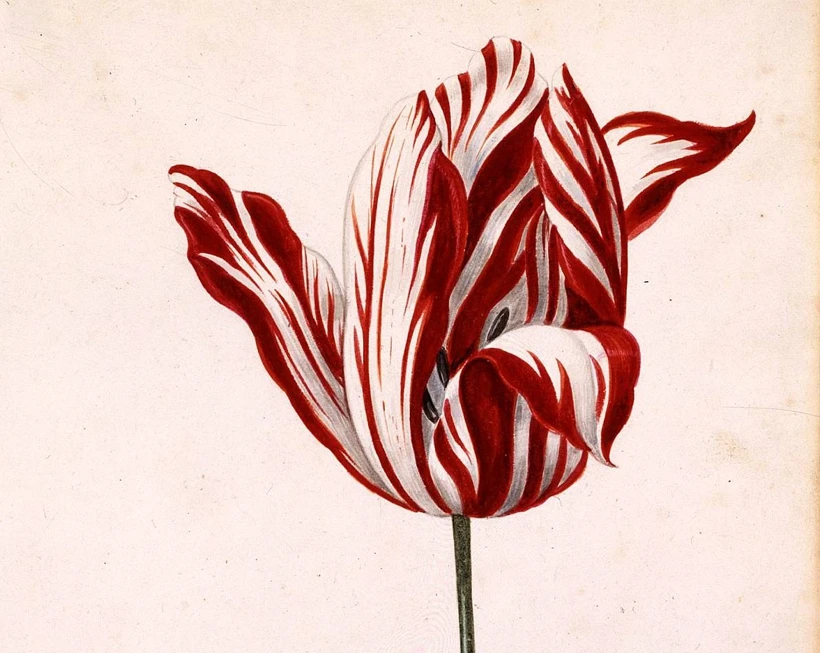
The most famous tulip bulb is the Semper Augustus, recognizable by its flamed stripes. In 1623, Nicolaes van Wassenaer, an Amsterdam physician and scholar, declared the Semper Augustus the tulip of the year. Centuries later, in 1930, it was discovered that the flamed stripes on the flower were caused by a virus: the tulip breakage virus.
Tulip Mania
In 1634, the real Tulip Mania began. Speculators (today’s stockbrokers) threw themselves into the tulip trade in the hope of getting rich quickly. For a single Semper Augustus bulb, 10,000 guilders were paid—the same price as a canal-side house… with a garden!
This so-called “wind trade” (making a profit on speculative grounds) was centered on selling hot air through contracts that could never be fulfilled.
1637: Tulip Mania
In 1637, speculation in tulips escalated into a frenzy and caused the world’s first stock market crash. We refer to this period as Tulip Mania.
In 1636–1637, public opinion began to turn against the tulip speculators. Gambling was considered a sin, and speculation was starting to look very much like it.
On the evening of Tuesday, February 3, 1637, the speculative tulip trade in Haarlem collapsed and prices plummeted. The tulip trade gained a bad reputation, and many speculators were left empty-handed. It was the very first stock market crash. From that moment on, the tulip remained popular, but now at more reasonable prices.
Did you know...
-
the Persian word for tulip (tulipan) means “turban”? In the 14th and 15th centuries, the tulip was adopted by the Ottoman Empire and was regarded as a guardian angel. Tulips were placed in their tulip-shaped turbans as relics.
- that the red tulip is still a Persian symbol of eternal love (just as the rose is in the West)?
-
that an early form of tulip mania also emerged in Turkey around 1500? New varieties were bred from wild tulips. There was even a severe penalty for stealing tulip bulbs.
- Around 1600, Dutch growers established the first nurseries on the outskirts of Haarlem; this marked the beginning of the Bulb Region!

More advice & inspiration
-
 Inspiration Create your own tulip oasis on your balcony
 -
 Inspiration Welcome to the Tulip Experience
 -
 Inspiration Mixing colors
 -
 Inspiration Plant instruction
 -
 Inspiration The dreamiest combinations
 -
 Inspiration Involve grandchildren in the gardening
 -
 Inspiration Tulip Experience Amsterdam
 -
 Inspiration Why are the tulip heads being removed?
 -
 Inspiration Harvesting and further treatment
 -
 Inspiration Pealing, sorting, counting and warehousing
 -
 Inspiration Packaging
 -
 Inspiration This is how we plant our bulbs.
 -
 Inspiration How does the tulip develop in winter.
 -
 Inspiration Create your own flower paradise!
 -
 Inspiration Exchange crops
 -
 Inspiration Why is the Bollenstreek the best place for growing tulips?
 -
 Inspiration Where do tulips come from?
 -
 Inspiration The Tulip That Became Worth Millions